Chitika

Showing posts with label Bizarre Crustaceans. Show all posts

Saturday, December 3, 2011

20 Interesting Facts About the Japanese Spider Crab

Here’s a list of the most amazing information about the gigantic Japanese Spider Crab.

1.) Japanese Spider Crab is known in Japan as Takaashigani which literally means “tall-footed crab”

2.) It is known scientifically known as Macrocheira kaempferi.

3.) This marine crab species can be found in the waters of Japan, hence the common name.

4.) The Japanese Spider Crab has the largest leg span of any arthropod in the world reaching up to 3.8 meters or 12 ft from claw to claw and weighing up to 41 pounds or about 19 kg.

5.) The body of this crab may grow to a size of 40 cm or 16 inches.


6.) The Japanese Spider Crab is unique from all other crab species. The first pleopods of males are unusually twisted, and its larvae appear primitive.

7.) In spite of its odd and ferocious appearance, this creature is known to have a gentle disposition

8.) The Japanese Spider Crab is orange, with white spots along the legs.


9.) Japanese Spider Crabs can be found off the southern coasts of the Japanese island of Honshu, from Tokyo Bay to Kagoshima Prefecture.

10.) They can also be found in Iwate Prefecture and off Su-ao, Taiwan.

11.) This unique marine creature can be found at depths of up to 600 meter, or as shallow as 50 meters.

12.) The Japanese Spider Crab is one of the most unusual aquatic pets in the world and requires a huge tank.

13.) In its natural habitat, this crab species feeds on animal carcasses and shellfish.

14.) The Japanese Spider Crab is one of the longest living creatures in the world living up to 100 years.

15.) Be careful in dealing with this gigantic crab because it has been noted that the crab was known to the Japanese for the serious injuries it can cause with its strong claws.


16.) This arthropod is edible and is occasionally collected for food with a total of 24.7 tonnes collected in 1976 and 3.2 tonnes in 1985.

17.) This crab which is subject to small scale fishery is centered in Suruga Bay.

18.) The population of Japanese Spider Crab has decreased in number, forcing fishermen into exploring deeper waters in order to catch them.

19.) The average size of Japanese Spider Crab caught by fishermen is a leg span of 1.0–1.2 meters.

20.) When its legs are spread out, an adult giant Japanese spider crab can measure 12 feet across and its body can grow to be 15 inches wide.

See also


Saturday, October 1, 2011

Weird, Unique and Commercially Important King Crab Species

King Crabs, which are also called Stone Crabs, are crab-like decapods crustaceans that are found mainly in cold seas and oceans. These sea-creatures are large and taste good. Many species of King Crabs are widely caught and sold as food.

Here’s a list of weird-looking, peculiar and commercially significant species of King Crabs.

Hapalogaster cavicauda


Hapalogaster cavicauda is perhaps the weirdest-looking king crab species in the world. It can be found in the Pacific coast of North America. This flattened crab-like crustacean grows to a carapace width of 2 cm and is covered in hair or setae.

Umbrella Crab (Cryptolithodes sitchensis)


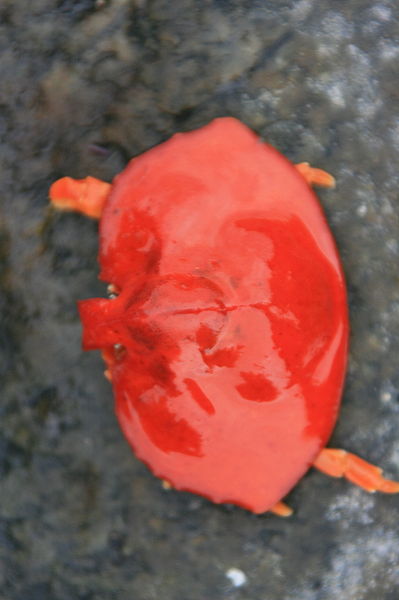
The unique-looking Umbrella Crab is endemic to the coastal regions of the northeastern Pacific Ocean from Sitka, Alaska to Point Loma, California. This crustacean that inhabits rocky areas is characterized by carapace that extends over its legs that when it pulls in its legs, it resembles a small stone.


This marine creature has a half-moon shaped carapace that extends over all of its eight walking legs hence it is also commonly called Turtle Crab and Helmet Crab.

Scaled Crab (Placetron wosnessenskii)


The Scaled Crab is a unique king crab species that can be found in the west coast of North America. Its coloration ranges from a clouded green to reddish sometimes with banding along the legs. Ii is usually found at depths of up to 110 meters.

Blue King Crab (Paralithodes platypus)


The Blue King Crab on the above picture was photographed at Saint Petersburg Museum of Zoology, Russia. This peculiar-looking crab can be found n the several islands of Alaska, Japan and Russia.  

Blue King Crabs from the Pribilof Islands are the largest of all the king crabs, sometimes exceeding 8.2 kg in weight. Blue King Crabs are among the most important king crab species harvested for human consumption.

Lithodes maja


Lithodes maja is a spiky or thorny king crab species that can be found in the cold waters of North America and Europe. Its carapace can reach a width of 14 cm and covered with large spikes.

Southern King Crab (Lithodes santolla)


The Southern King Crab is another king crab species with a body completely covered with large spike. This brightly-colored crab is known as Centolla in Argentina, Chile and Peru. It can be found off the Pacific coast of South America.

Red King Crab (Paralithodes camtschaticus)


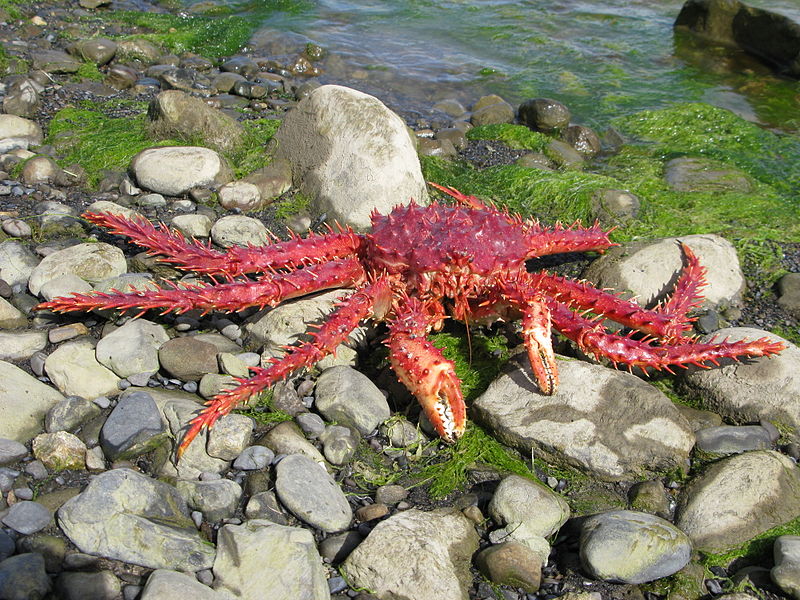
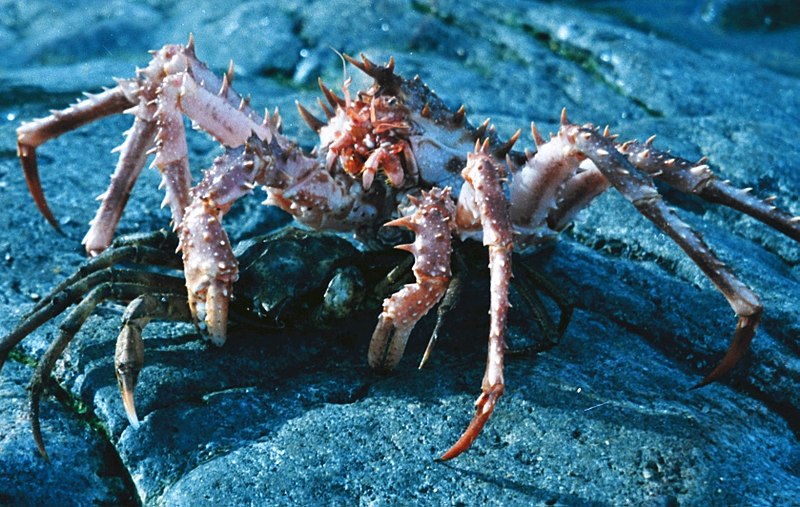
The gigantic and colorful Red King Crab is the most economically important species of king crab. It is endemic to the Bering Sea and grows to a leg span of 1.8 m. Due to its large size and good tasting meat; it is heavily targeted by fisheries. This huge crustacean was named after the color it turns when it is cooked rather than the color of a living animal, which tends to be more burgundy

See also

Tuesday, September 13, 2011

World’s Most Colorful and Unique Porcelain Crabs


There are about 277 species of porcelain crabs known. Porcelain Crabs belong to Porcellanidae family of decapods crustaceans. These marine animals superficially resemble true crabs. These crabs are known for their colorful and glossy shells.

Here are some of the most beautiful and distinct species of porcelain crabs in the world.

Porcelain Anemone Crab (Neopetrolisthes maculatus)


This beautiful Porcelain Crab is on a Carpet Anemone. The Porcelain Anemone Crab or Neopetrolisthes maculatus and other porcelain crabs such as N. ohshimai, N. alobatus and N. spinatus live on sea anemones.

Neopetrolisthes ohshimai


Neopetrolisthes ohshimai is a colorful spotted porcelain crab species. It can be found in the northwestern Pacific Ocean. This small and colorful crustacean with porcelain-like shell is usually found within the stinging tentacles of a number of sea anemones species

Long-clawed Porcelain Crab (Pisidia longicornis)


The Long-clawed Porcelain Crab is a brightly-colored porcelain crab species that can be found in the north-eastern Atlantic Ocean from Norway to Angola. It can be found also in the Mediterranean. Its color varies from reddish or orange to white. Its carapace grows up t 1 cm.

New Zealand Half Crab (Petrolisthes elongates)


One of the weirdest-looking but colorful crab in the world is the New Zealand Half Crab. This porcelain crab species was commonly named because of its appearance. It can be found in New Zealand and Tasmania.

Broad-clawed Porcelain Crab (Porcellana platycheles)


The Broad-clawed Porcelain Crab is another weird-looking porcelain crab species due to its hairy appearance. It may reach a size of 1.5 cm and is found in the Eastern North Atlantic Ocean and Mediterranean Sea. This porcelain crab feeds on carrion and other organic debris.

See also

Sunday, August 28, 2011

Freakiest And Weirdest Crabs in The World

Freakiest And Weirdest Crabs in The World

See some of the world's most unique and bizarre crabs. These crabs are truly and amazingly unique in physical appearance. Check it out!

Sponge Crab (Dromia personata)


Image Source

This species is unique because its body and legs are covered with hairs giving the crab a furry appearance. The body of this crab is often covered by an encrusting sponge, but is recognized by its distinctive pink pincers and the very small fourth and fifth legs.

Reaction

Explore

Custom Search

Chitika

Chitika

Chitika